CPA FAQs – Guided Learning (2026)
Find answers to common questions about your CPA journey, including study tips, exams, results, and enrolment.
During Semester FAQs
I am not getting the weekly emails – what should I do?
You must access Guided Learning via MYOL on the CPA Australia website.
This adds your subject to your dashboard and includes your email in the subject mailing list.
Important: Do this for every subject you are enrolled in.
What are the links to the Facebook groups?
Do the MST and Practice Exams count toward my final grade?
No. Your final CPA result is based 100% on the final exam.
Mid-Semester Test (MST) dates
Released: Week 4 (Friday)
Closes: Week 6 (Tuesday)
Semester 1, 2026:
26 February (2pm) → 9 March (11:59pm)
Practice Exam dates
Practice Exam 1: 24 March (2pm)
Practice Exam 2: 27 March (2pm)
Both remain available until the end of the semester.
Ask The Expert (ATE) forum dates
Available from semester start until just before exams.
Semester 1, 2026:
2 February → 10 April
Exam FAQs
What is the pass mark?
CPA does not publish a fixed pass mark.
This is very unusual and might feel a bit uncomfortable, but CPA Australia used a special process to set the pass mark and it is not as simple as saying ‘50% is the pass mark’.
Why?
The pass mark is determined based on identifying what the ‘minimally competent candidate’ is. So it could be 40%, 53%, or 65% – depending on the subject and exam difficulty level and what a panel of experts determine a minimally competent candidate should achieve.
Should you be worried? No
How do you know if you are likely to pass?
Simple: Do the practice exams.
You then get an estimated grade based on your result based on data from thousands of people who already did the practice exams and the final CPA exam and had the data compared.
Check out this blog post that has the Estimated Grade for results in every subject and explains how to get an estimated scaled score:
What happens if I don’t click submit?
Your exam will automatically submit when time runs out.
All answers are saved during the exam.
What can I bring into the exam?
- Hardcopy study guide (annotated)
- Calculator
- Printed or handwritten notes
- Dictionary
Not allowed: laptops, Excel, online materials, blank paper and pen(s).
How do I know if my calculator is acceptable to take into my CPA exam??
You can take any calculator into your exam, including a scientific calculator or a financial calculator, as long as it does not have any data storage or recording functions, and its primary purpose is a calculator.
CPA Australia will not provide you with a list of appropriate models, because there are so many to choose from.
There is a simple test: Can you do all the calculations that you have found throughout the study guide?
If the answer is yes – then, the calculator will be adequate. If not, then we’d recommend you invest in an appropriate calculator.
An onscreen scientific calculator is provided to you in your exam.
You can buy a reasonable scientific calculator for about $30.
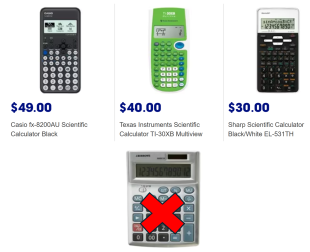
Check out this link:
Should I defer?
Defer if: you are far behind early and cannot catch up.
Otherwise:
- Keep studying
- Attempt Practice Exam 1
- Use your estimated grade to decide
- If you choose to defer, you can access Guided Learning up until MYOL is disabled. If you defer you need to login directly to our website rather than via the CPA Website.
How do the practice exams compare to the final exams?
The practice exams are comparable in length, structure and difficulty to the final exams.
In some subjects like Financial Reporting and Digital Finance ours seem to be a little bit harder.
In other subjects like Ethics & Governance our seems to be a bit easier.
This does not matter or affect your result.
If you find the final exam harder, this doesn’t mean you panic and say you will fail.
Why does the final exam feel much harder?
You are under pressure and stress and you know the result counts for something
You do not get to see your result immediately or the solutions and so questions feel more difficult
You may get stuck trying to prove every answer by referencing the study guide and run out of time, instead of just trusting your knowledge
You may be much more tired because you haven’t slept well or been stressed before the exam
Very talented students get upset when they can’t answer a few questions and that feeling taints the whole exam experience
Will you pass even if you found the exam hard?
Compare your practice exam result to the estimated grade table – this will give you the best comparison available.
Check out the following link:
CPA Results FAQs
I failed – what should I do?
When you fail it can really hurt – especially if you feel you did the work and were not expecting the result.
Here is some guidance on what to reflect on to help you move forward.
How did you prepare for your exam? Here are a few things to reflect on:
Review your preparation honestly:
- Did you study consistently?
- Did you complete the mid-semester test as well as the two practice exams?
- Did you manage your time well? Did you study actively and regularly – did you write your own notes/index?
- Did you use Guided Learning effectively – going through the units, watching videos, attempting all the quizzes??
- How many times did you go through the study guide?
- Were all questions in the study guide attempted and understood?
You’ll need to re-enrol (no supplementary exams available).
I failed – Can I apply for special consideration?
No.
Once results are out you cannot apply.
Please note that special consideration with CPA is very different to University.
At university you may be granted a pass even if you scored quite a level below the pass mark. However, with CPA, it is only going to be relevant if you were very close to the pass mark (i.e. 538 / 539) as you must still demonstrate competence. It is not as generous as university level. They also don’t provide for re-sits and require you to enrol again for another whole semester.
Special consideration is applied for after sitting your exam if you faced circumstances beyond your control which would affect your exam preparation or exam performance.
Check out the following link for more Guidance:
I failed – Can I sit a supplementary exam or ask for a review of my CPA exam?
No.
CPA do not provide supplementary exams.
CPA do not allow for reviews and will not do it once results have been released. They will also not allow you to apply for special consideration after results are released.
There are over 20,000 enrolments a semester, and the average fail rate is 35% of people.
So if CPA allowed for reviews there would be thousands required. So, they check every exam carefully prior to results being published, so a review is unnecessary.
You will be required to enrol again for another whole semester.
I failed – Should I repeat the same subject?
Why should I do a different CPA subject?
Reason 1: The majority of people who repeat a CPA subject fail it on the second attempt.
Why? Not because it is too hard. It is because they do not do enough work the second time.
The behaviour pattern goes like this: I scored 530 and I needed 540. So, I will repeat the subject as I only need 10 more to get a pass. So, I will study the modules I did bad in, and assume my other modules will stay at the same level. I will start studying about week 7.
Result: You get 530. You do better in the modules you previously did badly in.
You do worse in the modules you previously did well in. You end up getting the same score or lower.
Solution 1: Do the CPA subject again as if you have never seen it. (This is virtually impossible…you will skim read pages…you will skip over quizzes…you will get bored).
Solution 2: Do a different CPA subject. Then, when you come back to the CPA subject you failed you will have fresh eyes.
Most students perform better by switching subjects and returning later with a fresh perspective.
I failed – Should I do 2 subjects to catch up?
No (especially if you’ve failed before).
Think about why.
You just failed a subject, so what chance have you got of passing two subjects?
You may easily fall into the trap discussed above of not doing enough work. If you scored 530 you don’t need to just get 10 more marks to get to 540. You have to treat it like a new subject.
Result: You will most likely fail at least one subject (probably the one you previously failed) or you will fail both subjects, because you are spread too thin.
Solution 1: Your career is going to last many decades. It does not matter if you take an extra 6 months to finish the CPA Program. Less stress. More success. Just do 1 subject at a time.
Solution 2: Try and do 2 subjects. Maybe pass. Maybe lots of stress and pressure. Maybe fail. Who needs that?
Should I keep going or quit the CPA Program?
Sometimes it is good to not give up.
But, if you are not really in a position to successfully pass the subjects then you have to consider the cost and time you are devoting to the CPA Program and whether it is better to pause your studies or discontinue completely.
If you have consistently failed subjects, if you are scoring in the 400s, if you have repeated a subject several times and are not improving your result – these are all good reasons to to pause your CPA studies.
If you are close, but not getting through, this is an expensive and stressful process to work through.
You may find that with a 2 year break you can come back to your studies with more energy and knowledge, and then perform really well. The aim is not to get a 540 and just get through. It should be about mastering the material, so you can get 600+ and pass confidently and easily.
If you are unsure what to do – please email us at help@Keq.com.au and also include your scaled score results PDF for the subjects you have attempted.
I am running out of time to finish my CPA Program, will CPA give me an extension?
Short answer = Yes
Longer answer = Yes – in nearly all situations, if you can show CPA Australia you are working towards completing the program then you can continue. This rule is designed to stop people who sign up as Associate Members and never intend to actually do the CPA Program and become full members, but still take advantage of calling themselves a member of CPA Australia.
I need specific help or guidance with what to do next – can you help?
Yes we can.
We can give you more specific guidance and help depending on your situation. For us to be helpful, when you email us, please send through:
- A copy of your result / scaled score, so we can see your overall score and your result by module
- If you have failed more than once please send the results for each attempt you have made.
- A description of how you study
- How often each week
- How long you spend each study session
- How you study – e.g. things like how you summarise, take notes, create an index, attempt questions
- How you went in your practice exams, and when you did them compared to your final exam (e.g. 1 week before)
I passed – what do I do now? Do I start studying straight away?
Please don’t try and start studying straight away.
Give yourself a break…
Then set a start time such as 5 January to get a great headstart on semester
Then dive in properly
To get started – scroll down to the bottom of this page – you can get our FREE Module 1 CPA Assist resources including quizzes, videos and webinars. Just click on the subject you plan to study
I passed – How is a Credit, Distinction or High Distinction worked out?
All candidate results are plotted on a curve.
You can work out a standard deviation on this curve, and a Credit is 1 standard deviation above a Pass.
Distinction is 2 standard deviations. HD is 3 standard deviations.
So, in some subjects there is a wider, flatter graph, and in other subjects a taller, narrower graph. So, that is why a particular scaled score in one subject may be a Distinction but in another subject it is only a credit.
Check out this blog post that explains how to get an estimated scaled score:
What is the easiest subject in the CPA Program so I can decide what subject to do next?
This is the wrong question! Better questions are:
1. Which CPA Subject will best help me in my career?
2. Which CPA Subject will I find the most interesting?
There is no correct answer to which is easiest, because what is easy for one person is not easy for another:
a) Technical subjects like Financial Reporting (FR), Financial Risk Management (FRM) and Taxation (AT and ATA) are easy for some people who like to follow specific rules and checklists, and hard for others who are less disciplined to work through every step.
b) Conceptual subjects like Ethics & Governance (EG), Contemporary Business Issues (CBI) and Global Strategy & Leadership (GSL) are easy for some people who like concepts, ideas and lots of stories and examples. But, some people find these extremely hard and ambiguous, because they prefer clear rules for everything.
As an example, I find EG, SMA, CBI and GSL very easy. I can read them once and grasp them well and remember them clearly. But, FR, FRM and Tax for me are hard work. I can still learn them, but I have to really work at them. So, each person is different.
Some other things to keep in mind are:
Try not to use previous semester CPA pass rates as a factor to inform your subject selection.
Try not to be influenced by the opinions of others on the difficulty levels of subjects as what one person finds difficult, another person might find easy.
If you have deferred or failed a subject, don’t just assume that you can/should take multiple subjects the following semester to ‘catch-up’. You need to make sure you have the time and discipline to get through both subjects – you don’t want to dig yourself into a deeper hole!
Length of the study guide (for instance number of modules or number of pages) is not always relevant. Some people find it much easier to master technical, rule based content – while others prefer conceptual and narrative based reading.
I passed my final subject – am I now a CPA?
Most members need to complete three requirements to become a CPA:
- CPA subjects
- Relevant work experience
- Approved degree
If you’ve already completed your experience and degree, and you’ve just passed your final subject, CPA Australia will review your profile and you’ll be notified of your new CPA status via email. This can take a couple of weeks from when you receive your result, so please be patient. CPA Australia will let you know as soon as possible.
If you became an Associate member via a Mutual Recognition Agreement, you may also need to complete the professional development course Better practice in governance and accountability in order to advance.
If you believe you’re eligible to advance to CPA status but haven’t received notification from CPA Australia within a month of finishing your requirements, please contact CPA Member Services (memberservice@cpaaustralia.com.au).
I passed what subject should I do next?
We recommend that you complete the compulsory core subjects first then complete your electives.
Subject Order:
1st – Ethics & Governance (EG)
2nd – Strategic Management Accounting (SMA)
3rd – Financial Reporting (FR)
4th – Global Strategy & leadership (GSL)
5th – Elective 1
6th – Elective 2
CPA Subject choice tips:
– Don’t leave FR until last, even though it is really tough. If you get stuck on FR you want to find out earlier rather than later, so you can decide whether to continue with your studies.
– Don’t do AAA before FR; Audit involves careful consideration of IFRS which are covered in FR.
Most people must do the 4 CPA compulsory core subjects plus 2 electives. In this situation you cannot do GSL until you have completed the other 3 compulsory core subjects. Some people are given exemptions. Others have no electives and must do specific subjects as electives.
- 1. Why start with the compulsory core subjects? There is no point doing electives until you have mastered the core. If you cannot master the core, then you cannot complete the program. If you start with electives and only after that attempt the core, you may find out much later that you are not going to continue with your CPA studies due to the difficulty level or other reasons.
- 2. Why start with Ethics and Governance first? It is the introduction course to becoming a professional accountant. It introduces concepts that are explored further in later subjects. For most people it is also the easiest core subject. So, it is best to start the CPA Program here. This is the time to learn how to study online and without the typical support and structure you get at university level.
- 3. Why Strategic Management Accounting (SMA) second and Financial Reporting (FR) third? SMA is more difficult than EG but not as hard or time consuming as FR for most people. So, this is the second stage in mastering the CPA Program. Many people find the jump from EG straight to FR too hard. They do not put in enough work and find it very stressful and often fail. So, EG, then SMA then FR is the best progression that supports your successful completion of the program.
- 4. Why Global Strategy and Leadership (GSL) fourth? Shouldn’t it be last? Theoretically, it should be last. GSL is a capstone subject that brings all your CPA studies together. But, because it is a compulsory core subject, we think it is best to do before your electives. If you cannot make it through this subject, there is little benefit in doing the electives as you will not successful complete the CPA Program.
- 5. Which elective should I choose? Do the subjects that are likely to assist with your future career direction. Getting your accreditation as a CPA is critical, but you should have also mapped out some idea of where your next career steps will likely be. There is no ‘easiest’ CPA Subject. They are all hard. So, do not try and choose the CPA elective that is easiest.
Some useful examples:
Public Practice or Technical Accountant: Advanced Audit & Assurance and Australia Taxation.
Tax Practitioner: Advanced Audit & Assurance and Australia Taxation and Australia Taxation – Advanced would be the best fit.
Accountant in Business / Consulting: Contemporary Business Issues & Digital Finance.
Management Accounting / Treasury: Contemporary Business and Financial Risk Management.
Study & Subject Selection
Recommended subject order
- Ethics & Governance
- Strategic Management Accounting
- Financial Reporting
- Global Strategy & Leadership
- Electives
CPA Subject choice tips:
– Don’t leave FR until last, even though it is really tough. If you get stuck on FR you want to find out earlier rather than later, so you can decide whether to continue with your studies.
– Don’t do AAA before FR; Audit involves careful consideration of IFRS which are covered in FR.
Most people must do the 4 CPA compulsory core subjects plus 2 electives. In this situation you cannot do GSL until you have completed the other 3 compulsory core subjects. Some people are given exemptions. Others have no electives and must do specific subjects as electives.
- 1. Why start with the compulsory core subjects? There is no point doing electives until you have mastered the core. If you cannot master the core, then you cannot complete the program. If you start with electives and only after that attempt the core, you may find out much later that you are not going to continue with your CPA studies due to the difficulty level or other reasons.
- 2. Why start with Ethics and Governance first? It is the introduction course to becoming a professional accountant. It introduces concepts that are explored further in later subjects. For most people it is also the easiest core subject. So, it is best to start the CPA Program here. This is the time to learn how to study online and without the typical support and structure you get at university level.
- 3. Why Strategic Management Accounting (SMA) second and Financial Reporting (FR) third? SMA is more difficult than EG but not as hard or time consuming as FR for most people. So, this is the second stage in mastering the CPA Program. Many people find the jump from EG straight to FR too hard. They do not put in enough work and find it very stressful and often fail. So, EG, then SMA then FR is the best progression that supports your successful completion of the program.
- 4. Why Global Strategy and Leadership (GSL) fourth? Shouldn’t it be last? Theoretically, it should be last. GSL is a capstone subject that brings all your CPA studies together. But, because it is a compulsory core subject, we think it is best to do before your electives. If you cannot make it through this subject, there is little benefit in doing the electives as you will not successful complete the CPA Program.
- 5. Which elective should I choose? Do the subjects that are likely to assist with your future career direction. Getting your accreditation as a CPA is critical, but you should have also mapped out some idea of where your next career steps will likely be. There is no ‘easiest’ CPA Subject. They are all hard. So, do not try and choose the CPA elective that is easiest.
Some useful examples:
Public Practice or Technical Accountant: Advanced Audit & Assurance and Australia Taxation.
Tax Practitioner: Advanced Audit & Assurance and Australia Taxation and Australia Taxation – Advanced would be the best fit.
Accountant in Business / Consulting: Contemporary Business Issues & Digital Finance.
Management Accounting / Treasury: Contemporary Business and Financial Risk Management.
Should I do 2 subjects at once?
Not recommended for most students.
Especially avoid combining:
- Financial Reporting
- Advanced Taxation
Is the study guide changing for my subject next semester and what are the current editions?
We do not know. CPA will release this information just before enrolments open for Semester 2, 2026.
The current study editionas are:
- Ethics & Governance – 4th edition
- Strategic Management Accounting – 3rd edition
- Financial Reporting – 6th edition
- Global Strategy & Leadership – 3 edition
- Advanced Audit & Assurance – 7th edition
- Australia Taxation – 8th edition
- Australia Taxation – Advanced – 11th edition
- Contemporary Business Issues – 5th edition
- Digital Finance – 1st edition
- Financial Risk Management – 4th edition
How many study hours would you recommend I study for my subject?
Our recommendations are as follows
- Ethics & Governance – 120 hours
- Strategic Management Accounting – 140 hours
- Financial Reporting – 165 hours
- Global Strategy & Leadership – 120 hours
- Advanced Audit & Assurance – 120 hours
- Australia Taxation – 150 hours
- Australia Taxation – Advanced – 200 hours
- Contemporary Business Issues – 120 hours
- Digital Finance – 120 hours
- Financial Risk Management – 120 hours
Which subject require a scientific calculator?
The following subjects require a scientific calculator:
- Strategic Management Accounting
- Financial Reporting
- Advanced Audit & Assurance
- Australia Taxation
- Australia Taxation – Advanced
- Financial Risk Management
Remember in your final exam you will also have access to an online calculator.
What are the current corrections and FAQs for my subject?
Take a look at this page:
Getting Started
Start early. Ideally 2–3 weeks before semester starts.
Don’t wait for printed study guides — begin with digital materials.
Is the study guide changing for my subject next semester and what are the current editions?
We do not know. CPA will release this information just before enrolments open for S2, 2026.
The current study editionas are:
- Ethics & Governance – 4th edition
- Strategic Management Accounting – 3rd edition
- Financial Reporting – 6th edition
- Global Strategy & Leadership – 3 edition
- Advanced Audit & Assurance – 7th edition
- Australia Taxation – 8th edition
- Australia Taxation – Advanced – 11th edition
- Contemporary Business Issues – 5th edition
- Digital Finance – 1st edition
- Financial Risk Management – 4th edition
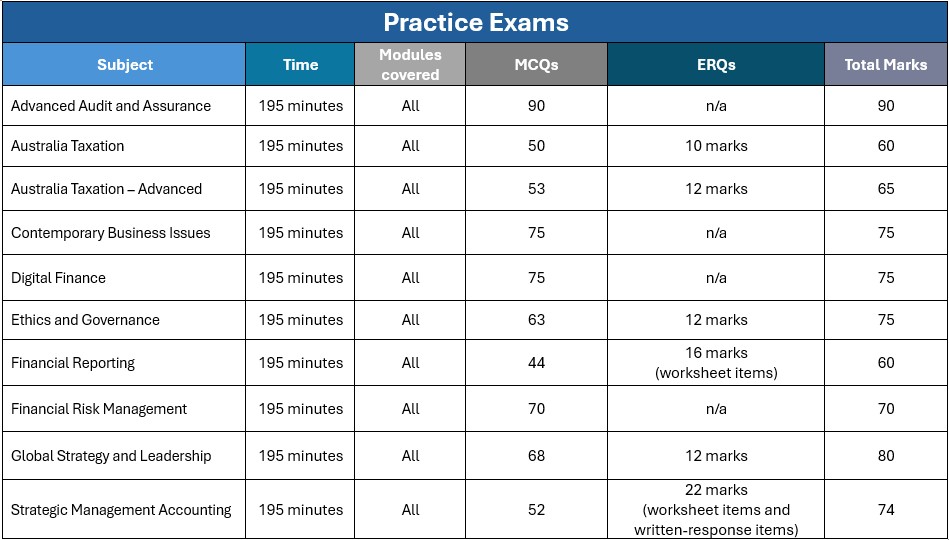
What is my exam structure for my CPA Program subject?
Take a look at the following link for guidance:
When will I get the hardcopy of my study guide?
Study guides are only sent to you by mail after the closing date for cancellations with a refund (6 July).
CPA Program Study Guide PDFs are available when you enrol in your subject. Print out Chapter 1 and start studying immediately – don’t wait for the hard copy.
Why should I enrol early and when should I get started?
1 – You get a copy of the study guide PDF (use Control S to save it to your computer).
2 – You have a wider range of exam time choices
BUT
You will not get the hard copy study guide any earlier. They are only mailed out when the free cancellation date passes.
You should start studying at least 3 weeks before the official start of semester. So do not wait for the hardcopy. Print out the first module or two and get working.
Join Our Facebook Groups
- Ethics & Governance
- Financial Reporting
- Global Strategy & Leadership
- Strategic Management Accounting
- Advanced Audit & Assurance
- Tax (Australia Taxation & Australia Taxation – Advanced)
- Contemporary Business Issues
- Digital Finance
- Financial Risk Management